
Continuing Education Classes & Descriptions
Below is a list of classes available at various times. All are available to CERT Basic Class graduates (with some age restrictions) and a few of these are also available to the public.
Registration opens 90 days in advance of the class date.
***** WARNING *****
Registrations recorded before 90 days in advance of a class will be removed when the registration officially opens for the class.
Available to Everyone
Be Stroke SMART
Every 40 seconds someone suffers a stroke! Every 4 minutes someone dies from a stroke! Strokes are the 3rd Leading cause of Death for women and the 4th leading cause of death for people over 65 years old. Do you know how to spot a stroke before it is too late to save a life? This short class (1.5 hours) will inform you of the cause of strokes and how to recognize them early enough to save a life and minimize the potential for disability. The life you save could be your parent, sibling, or your life partner. By sharing this information, you may save your own life!
CERT Emergency Preparedness Workshop
Be Ready for Emergencies. Act ahead of time to be ready for an emergency (PREPARE). This helps protect life and property in an emergency (Respond), rebuild from an emergency (Recover), and Mitigate or minimize the effects of emergencies. The Workshop planning approach helps prepare for emergencies using four actions to take that make a difference. Creating Plans, Being Informed, Building Kits, and Getting Trained. With these actions you can reduce the potential impact of emergencies (disasters) from threats and hazards to save lives and reduce trauma. This workshop is designed as two sessions and with a pre-course one-page draft plan as homework. (Before the course starts). The first is a virtual presentation and discussion. Between the first and second session you have the time to explore several decisions and finalize checklists for action planning that is critical for successful emergency preparedness. The second session is an in-person workshop to finalize your emergency preparedness plan, check out emergency kits, and explore emergency food pantry items and safe drinking water sources. We”ll even taste test a couple of types of emergency meals. This course is open to and recommended for the public.
Opioid Overdose Training – Narcan/Naloxone
Opioid Overdose and Naloxone Education trainings (REVIVE Training) teaches individuals what to do and not do in an overdose situation, how to administer naloxone, and what to do afterwards. Upon completion of the training participants receive a free box of naloxone so they will have it if they need it.
Stop The Bleed
A person who is bleeding can die from blood loss within five minutes. While emergency responders will arrive as quickly as possible, bystanders are almost always there first. In the case of disaster and high-casualty incidents, emergency services are often spread thin. This is where Stop The Bleed! helps. This training program will teach you to stop severe bleeding and Save a Life! WILL YOU BE READY? STOP THE BLEED is a training program created to train bystanders in life-saving techniques. With the rise of active shooter situations in schools, churches, public meeting places, malls, government facilities and even office buildings, it is vital that individuals are trained in basic life-saving techniques, such as how to properly use a tourniquet, hemostatic blood clotting agents, such as QuikClot, or even apply a chest seal. Everything that can be done to save a person’s life is done in the first five minutes! What would you do if you were faced with the unimaginable?
Surviving an Active Shooter
This course will cover the actions you should take in an active shooter situation including the basics of Run, Hide, Fight.
Available to CERT Basic Trained Personnel
American Sign Language for Emergency Response
American Sign Language (ASL) is a visual language used in the North America to communicate with individuals that are deaf or hard of hearing. With signing, the brain processes linguistic information through the eyes, facial expressions and body movements. All play an important part in conveying information. Individual signs are relatively easy to learn. For basic communication, and to sign them comfortably, can take a significant period of time, patience, practice, and a good dose of a sense of humor to learn. Like any spoken language, ASL is a language with its own unique rules of grammar and syntax. Thus, everyone learns sign language at their own speed. The time and effort it takes to learn ASL can be very rewarding. Getting the message across, connecting with another person, being able to understand their situation and their needs is vital in an Emergency Response. Learning ASL will bring the rewards and will prove to be well worth the effort!
Animal Response
This 3-part course discuss topics related to emergency management, disaster planning for animals, very basic animal behavior, and possible roles with CERT in animal response.
Community Assessment Program (CAP)
During a natural disaster or storm the Emergency Operations Center needs to gather impact information quickly to make decisions about where to send limited resources to do the greatest good. CERT, as trained responders, can help identify issues in their neighborhood and report them through the Community Assessment Program (CAP) system. This vital link can have a significant impact on effective response by first responders. Attendees will learn how to leverage their smartphone to collect and submit CAP reports through the Fairfax County ArcGIS system. In this class we will review the purpose of the CAP, demonstrate and conduct hands-on training with the reporting system using your smartphone or tablet for capturing images, locations and entering descriptions of your findings. These are then shared electronically with the Fairfax County Emergency Operations Center. After submitting your report, you will be able to see the results of all reports on a live dashboard.
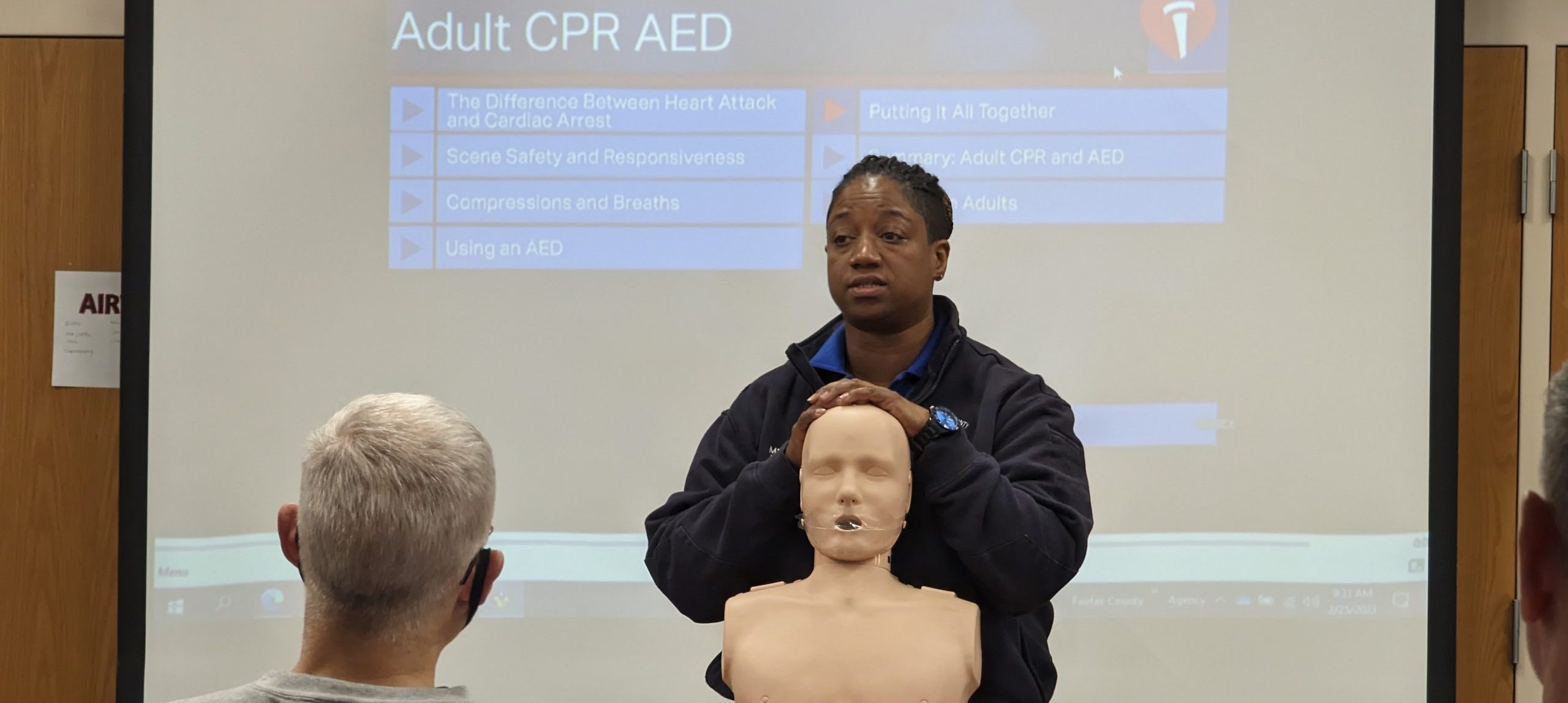
CPR/AED/First Aid
CPR – or Cardiopulmonary Resuscitation – is an emergency lifesaving procedure performed when the heart stops beating. CPR, especially if performed immediately, can double or triple a cardiac arrest victim’s chance of survival! You could be the difference between life and death for someone experiencing a cardiac event. Be ready to act by learning CPR.
Emergency Communications (Radio Communications)
In disasters and other emergencies telephones, computer, and radio communications serve to speed First Responders to where they are needed most. Radios are vital to emergency communications. Simple and consistent radio procedures essential. In Emergency Communications CERT members will learn:
1) Explore the importance of communications in an emergency,
2) Learn and practice the 4-C”s FRD radio protocol,
3) Explore the use of different communication modes and strategies,
4) Learn the basic features, settings, and use of a handheld radio in a simulated emergency scenario, and
5) Learn how to develop a communications plan.
Emergency Vehicle Operations Course (EVOC)
This training is for CERT/FRD EVOC trained individuals to get certified to drive CERT vehicles on routine missions.
FRD Radio Communications Class
This class is for CERT Support volunteers, EVOC drivers, and Canteen Team crew only. All CERT Support, EVOC drivers, and Canteen Team crew should take this course at least annually if they have not used the radio at least quarterly.
This class is specifically designed for CERT to teach them the basics for using the FRD radios appropriately.
What is covered:
FRD 4-C Communications protocol.
How to appropriately acknowledge when enroute to an urgent call.
How and when to switch channels (Dispatch to Command and Ops Channels).
How to respond to Dispatch (Fairfax) calls for estimated time of arrival (ETA).
When and how to call Command as you arrive on scene. (where do you want us)
How and when to respond to Personnel Accountability Report (PAR) checks.
How to report an emergency to Command from your location (e.g. FF collapses).
How to respond to a call from Command to go in-service and what to do next.
Upon leaving a scene, when and how to transition to the dispatch channel (4B).
Reporting an event on the road (accident, EMS, etc ) you are involved in or that you happen upon.
Hazmat – Introduction to Hazmat Awareness
Hazardous Materials are everywhere in a variety of containers. HAZMAT is a “STOP” Sign for CERT. However, we must be able to recognize HAZMAT where we encounter it if we hope to keep ourselves safe. No prior knowledge of the subject is required. At the end of the course, the participant should be able to: Discuss the two major hazardous materials identification systems used within the United States; identify locations where hazardous materials are commonly found and how to determine their potential health effects; be familiar with the DOT Emergency Response Guidebook 2024 (“ERG 2024”); describe what actions CERT can take to assess the situation prior to the arrival of professional responders.
Incident Management
This course helps develop your leadership skills for managing incidents with regards to five disaster leadership roles for CERT. During this course you will put your leadership skills into action with two tabletop activities and as a leader during a disaster exercise. This class examines the roles and responsibilities of the four leadership positions in a CERT Incident Management Team (Incident Commander, Accountability, Operations Chief, Team Leader, the Medical Branch Supervisor, and Medical Accountability.). The lecture will acquaint you with the principles and priorities that drive decision making, and the model that is used in each role. You will participate in a disaster exercise serving in one or more of the leadership roles identified.
Mental Health First Aid
You are more likely to encounter someone in an emotional or mental crisis than someone having a heart attack. Learn how to help a friend, family member, coworker or neighbor in need. About 1 in 5 adults in the U.S. in a given year has a diagnosable mental illness. Symptoms of mental illness can be difficult to detect – and even when friends and family can tell that something is wrong, they may not know how to help.
This Mental Health First Aid training course:
• Introduces risk factors and warning signs of mental health problems,
• Builds understanding of the importance of early intervention, and
• Most importantly, teaches how to help someone who is in crisis or experiencing a mental health or substance use challenge.
Miscommunication or Missed Communication: The Challenges of Hearing Loss for Emergency Responders
This program focus’ on understanding deafness and hearing loss as a disability, the impact of hearing loss in an emergency, amplification options, and effective communication strategies as well as apps that are useful tools as we deal with COVID masks. We”ll take a look at some statistics, the continuum of deafness and hearing loss, how to recognize whether someone is deaf or hard of hearing, major myths about the disability, and the speaker/listener/environment/message considerations in communication.
Pet First Aid/CPR
This is a 6-hour class for up to 12 people over 2 nights. the course includes:
Snout-To-Tail Assessment for Injury & Wellness
Canine & Feline CPR
Choking Management/ Rescue Breathing
Bleeding & Shock Management
Restraining & Muzzling
Assessing the Pet’s Vitals
Pet First Aid Kit Contents
Insect Bites, Stings and Snakebite
Heat & Cold Injuries/Seizures
Class includes instruction, hands-on practice with stuffed dogs, and a 40-page handbook, temporary muzzle, and wallet completion card for each participant to keep.
Radio Communications (See Emergency Communications)
Skywarn Weather Watcher
Do you have an interest in weather? Would you like to be able to help your local National Weather Service office by providing the ground truth on the atmosphere that we observe from radar, satellites and various reporting stations? Then consider attending the SKYWARN program Basic course. By attending this course, you will be trained by NWS personal to recognize features associated with developing, mature, and dissipating thunderstorms which cause hazardous weather such as lightning, flooding, hail, tornadoes and down bursts. The attendee will also learn basics about winter weather and tropical hazards. At the end of the course, you will be assigned a SKYWARN spotter number which will be maintained in the official database at the NWS in Sterling. You will also be directed how to report this vital weather information.
Simple Machines: Leveraging and Cribbing
During disasters like earthquakes, hurricanes and tornados, building and contents tend to shift and fall. People often end up under walls and equipment and are unable to extricate themselves. This course teaches CERT the basics of stabilizing, leveraging and cribbing operations to safely extricate victims using simple machines. It covers:
· Rules for Rescue, Lifting and Cribbing
· Definitions of terms and items
· Team composition and responsibilities
· Process used for Lifting and Cribbing
Class consists of classroom portion with a table-top exercise and a practical exercise.
Tent Training
Students will learn to set up and takedown the ASAP-18 tent.
Traffic & Crowd Management
Traffic and Crowd Management (TCM) training provides CERT members with the knowledge and special techniques needed to manage vehicle movement and pedestrians in planned and emergency situations. Simply applying basic CERT skills in many situations may not be effective in dealing with a crowd of bystanders or directing the safe movement of vehicles at an incident. The class teaches a basic knowledge of crowd behavior, CERT do’s and don’ts, the proper use of hand signals with or without a wand/baton, proper wearing of PPE, placement of traffic diversion devices, and the effective use of radio communications. You are encouraged to attend as a refresher or assisting with the drills/demos (i.e., driver/vehicle to simulate traffic).
Trailer Operations
This class teaches members the procedure for driving with a towable trailer. There is a practical evolution to the course. Tow vehicle and trailer are provided.
Wide Area Search (TEEX)
This class, offered by the Texas A&M Extension Service teaches how to conduct wide area searches, including use of maps and apps.